Putin Outlines Conditions for Ending War Following Trilateral Summit in Anchorage
The Russian leader denied responsibility for the invasion and urged Ukraine to accept compromise terms discussed with Trump and Xi.
 🏛️Politics
Photo: UNIAN
Key points
- Putin denies starting the war, blaming the 2014 events in Kyiv.
- Russia claims to have agreed to US-proposed compromise solutions.
- The joint declaration by the US, China, and Russia omits any mention of Ukraine.
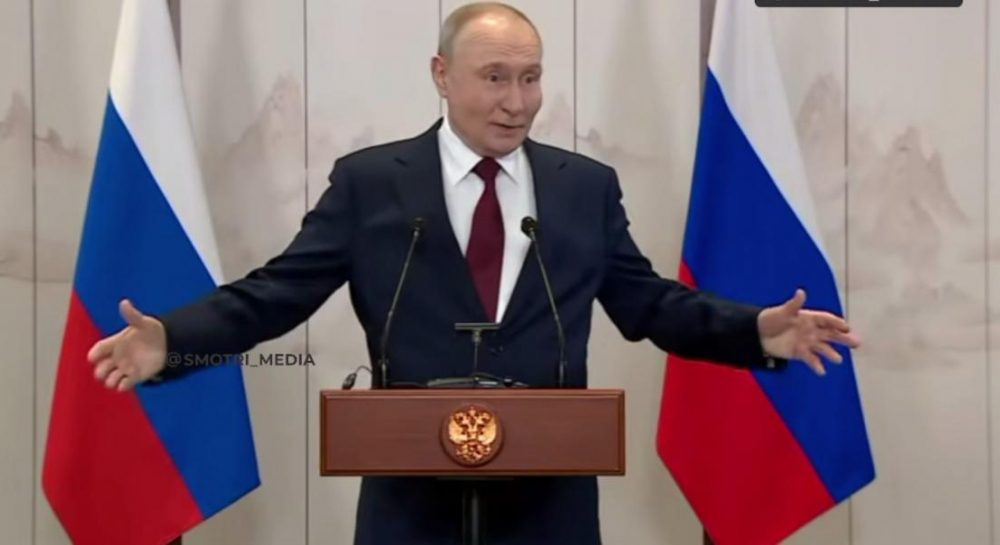
Following the trilateral negotiations in Anchorage involving the leaders of the United States and China, Vladimir Putin held a press conference detailing his vision for ending the war in Ukraine. Despite the high-profile nature of the meeting, the summit's official declaration bypassed the Ukrainian conflict entirely, focusing instead on energy supplies and nuclear safety. This creates an ambiguous backdrop for residents of de-occupied areas like Bucha, where the issue of a lasting peace is vital for reconstruction.
The Russian head of state once again employed manipulative rhetoric, claiming that Russia supposedly did not start the full-scale invasion but is merely attempting to end events that began in 2014. He blamed the current situation on the change of power in Kyiv a decade ago and subsequent actions by the Ukrainian government. Such statements directly contradict internationally recognized facts of aggression, yet they outline the Kremlin's position in talks with the new US administration.
The Question of Compromise and the 'Anchorage Agreements'
A key element of the speech was the mention of certain compromise solutions allegedly proposed by the American side. Putin stated that Russia is ready to implement them, and the ball is now in the court of Kyiv and European capitals. According to him, the Ukrainian leadership avoids a ceasefire due to a reluctance to hold elections under martial law.
Meanwhile, the joint statement by Donald Trump, Xi Jinping, and Vladimir Putin proved surprisingly brief regarding geopolitical crises in Europe. The document recorded agreements on the supply of petroleum products and nuclear safety measures, but contained no mention of Ukraine's territorial integrity or security guarantees for the region. This suggests that the Ukrainian issue may have been discussed behind closed doors without formalizing specific commitments.
"Only God knows what will happen next," Putin concluded when asked about the future consequences of the meeting.
For the Bucha community and the entire Kyiv region, such diplomatic maneuvers signify a period of heightened uncertainty. While world leaders seek common ground in the energy sector, the security of Ukrainian cities remains a subject of complex bargaining, the results of which will only become clear over time.
Source UNIAN — unian.ua/world/viyna-v-ukrajini-putin-zrobiv-nizku-brehlivih-zayav-… ↗
Read next
 👥Society
Autumn Rose Care: Expert Advice for Gardeners in Bucha
Experts explain why it is best to avoid radical pruning of roses until stable cold weather arrives.
 🇺🇦Ukraine
Estonia affirms Ukraine's right to self-defense following Gulf of Finland incident
Estonian Foreign Minister Margus Tsahkna stated that the strike on a Russian vessel is a consequence of Russia's war, upholding Ukraine's right to defend itself.
 🛡️Security
Rescue operation in Dymer: 89-year-old woman pulled from rubble
Search and rescue operations continue in Dymer, Kyiv region, after a drone strike on a residential building. The death toll has reached nine.
 🛡️Security
Russian corvette 'Merkury' in Libya: potential strike by Ukrainian drones
An explosion occurred on board a Russian military vessel in the Libyan port of Benghazi, with reports linking the incident to Ukrainian marine drones.
 🛡️Security
Russia tests NATO algorithms through airspace violations, expert says
Retired Ukrainian Colonel Dmytro Kashchenko stated that Russia uses drone and missile incidents within Alliance territory to test NATO's readiness.
 🇺🇦Ukraine
Climate Threat: Scientists Revive 40,000-Year-Old Bacteria from Permafrost
Researchers from the University of Colorado have discovered that microorganisms from permafrost can reactivate after thawing, potentially accelerating global warming.